The following eleven publications result from the project but do not exhaust the list of my texts published on medieval Poland and European political liturgies. More works can be found here.
For those interested in liturgica Poloniae, I referenced specific codices analyzed in the papers, though the scope of the publications is not limited to those manuscripts solely.
If you would like to receive full and free access to any of these texts, please contact me.
1. Political Liturgies in the European Middle Ages. Beyond the Legacy of Ernst H. Kantorowicz, eds. Paweł Figurski, Pieter Byttebier, Johanna Dale (Turnhout: Brepols, 2021).
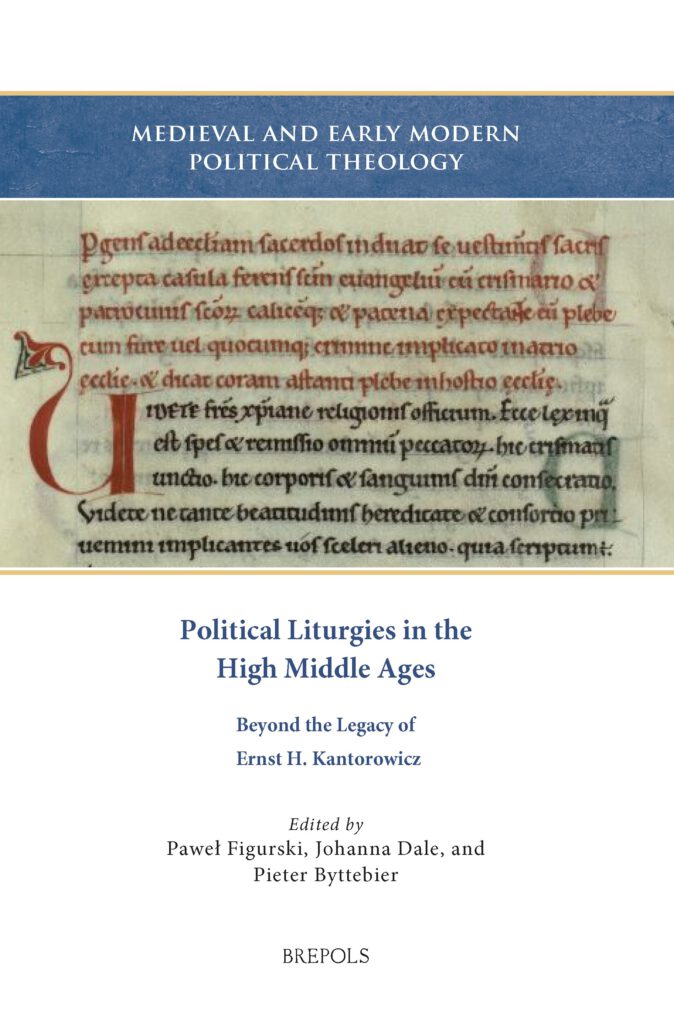
Innovative collection about the interaction of liturgy and politics in high medieval Europe, with a paper on early Polish ideology of power interpreted within Carolingian and post-Carolingian contexts.
*
2. “Medieval Liturgy and the Making of Poland. A Study in Early Medieval Political Identification (c. 960s-1030s),” Journal of Medieval History – submitted.
Although the issues of premodern ethnogenesis, early medieval state-formation, and political identification are the main fields of inquiry in the recent historiography, including in Polish academia, scholars rarely refer to liturgical sources, even when they discuss the significance of political rituals. Therefore, the goal of this paper is to examine identity formation in the Piast realms based on liturgical evidence that significantly contributed to political identification in medieval Poland.
*
3. “Sacramental Kingship: Modern Historiography versus Medieval Sources,” in: Political Liturgies in the High Middle Ages: Beyond the Legacy of Ernst H. Kantorowicz, eds. Paweł Figurski, Johanna Dale, Pieter Byttebier (Turnhout: Brepols, 2021), 25–60.
In the few examples, selected from the first hundred years of Carolingian rule, I have striven to demonstrate the liturgical construction of an idea that earthly rulers were perceived as signs of Christ’s kingship and sharers in certain sacramental features with the ordained ministers of the Church. I have also offered an overview of the Carolingian model attested at the peripheries of Latin Christianity: in the high medieval Polish kingdom.
The following manuscripts concerning medieval Poland were utilized in the paper:
D-DÜl C 91,
PL-Kj 2057,
PL-WRk 148,
PL-WRk 149 (150),
PL-GNd 149,
PL-PŁsem MsEPl 4,
PL-PŁsem MsEPl 3,
PL-Kk 23 (40).
*
4. (together with Grzegorz Pac) “Saints and Relics,” in: Handbook of East Central and Eastern Europe in the Middle Ages, 500-1300, ed. Florin Curta (London: Routledge, 2021), 338–53.
This paper examines the cult of saints in Central and Eastern Erupe. First, we dwell on the universal, “primary” saints venerated in this part of Europe, especially the Virgin Mary and St Peter, elaborating on their overarching functions for the emerging kingdoms. Second, we deal with the native saints, especially those venerated within the entire realms (as opposed to those venerated in one region or in one ecclesiastical institution only) and we discuss the theological and political meaning that their cults had for the local communities. Finally, we elaborate on native saints whose cults spread throughout the entire region and beyond, to show that the politically, socially, and religiously divergent traditions did not prevent mutual exchanges. Either brought from the outside or native to the region, saints moved freely between East Central and Eastern Europe and the rest of the Continent.
The following manuscripts concerning medieval Poland were utilized in the paper:
PL-PŁsem MsEpl 4,
PL-Kj 2057,
PL-WRk 347,
I-CFm 136,
and numerous edited sources.
*
5. “Liturgie polityczne, kultura rękopiśmienna w Kolonii oraz mity historyczne, czyli o proweniencji Sakramentarza Tynieckiego,” [“Political Liturgies, Cologne’s Manuscript Culture, and Historical Myths: The Provenance of the Sacramentary of Tyniec,”], trans. Natalia Czajkowska, in: Sakramentarz Tyniecki – perspektywa liturgiczno-muzyczna [Sacramentary of Tyniec—liturgical and musicological studies],ed. Susi Ferfoglia (Kraków: Tyniec Wydawnictwo Benedyktynów, 2020), 143–80.
My paper presents ample proof that the Sacramentary of Tyniec was not produced for any emperor, king, queen, or duke, and that there are no firm grounds to believe that it was written for or used in any Polish ecclesiastical institution in the eleventh or twelfth centuries. In order to prove these theses, I first briefly present the current basis for the opinio communis that there is a link between the Sacramentary and a monastery in Tyniec. Second, through a comparison of Sacramentary of Tyniec with other Ottonian and early Salian manuscripts – including codices demonstrably connected with the royal court – I demonstrate the improbability of any connection between the Sacramentary and a royal or ducal figure. Finally, I propose a different type of milieu within which the manuscript might have been produced and where it may have been used.
The following manuscripts concerning medieval Poland were utilized in the paper:
PL-Wn BOZ 8 (the main object of the analysis),
PL-PŁsem MsEPl 3,
PL-PŁsem MsEPl 1,
PL-PŁsem MsEPl 4,
PL-GNd 1a,
D-DÜl C 91.
*
6. “Beyond the Monarchical Church Model: Liturgy, Manuscripts, and Bishops in the Kingdom
of Poland. Case Studies from the Eleventh and Twelfth Centuries,” in: Bischof und Diözese
im Früh- und Hochmittelalter. Die ‘Episkopalisierung der Kirche’ im europäischen Vergleich,
eds. Hedwig Röckelein, Andreas Bihrer (Berlin: Walter de Gruyter, 2022), 361–404.
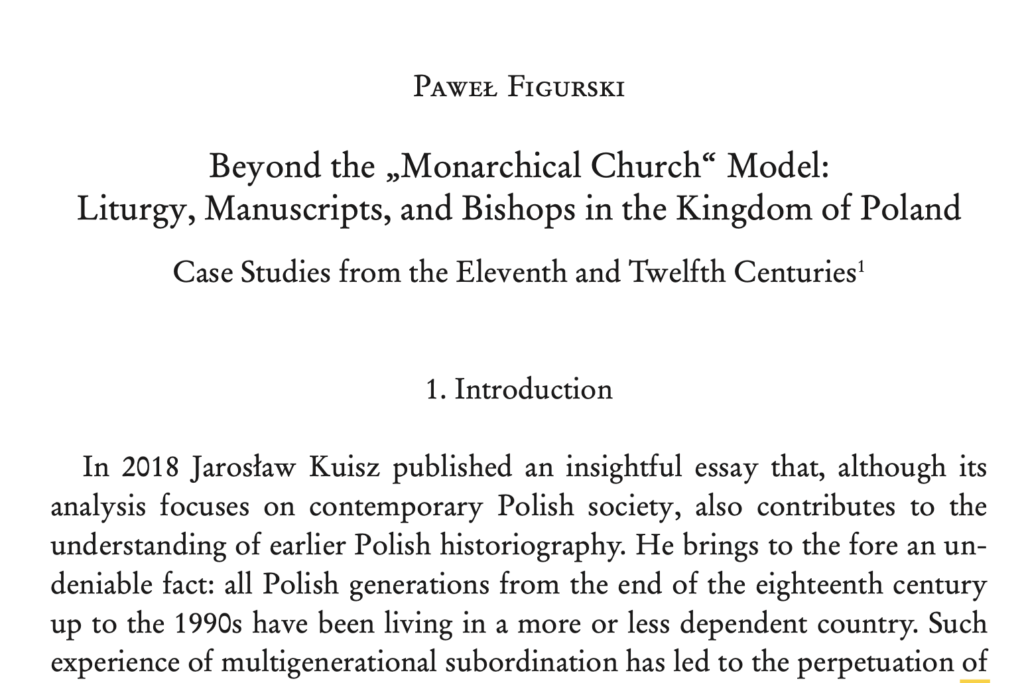
In this paper, I venture beyond the predominant historiographical framework of the “monarchical Church” and focus on other areas of episcopal activity, usually omitted from examination, but which were at the core of bishops’ activities—namely, the leadership in Christian worship. I argue that the liturgical manuscripts from the Piast realms, usually overlooked or analyzed outside of their proper societal and political context, shed light on the polyvalent agency of various bishops, including in respect to the Piast rulers. The codices from medieval Poland used during ecclesiastical services, if analyzed properly, tell a different story than that usually encountered in the narratives on the “monarchical Church”. This paper, although not examining the foundations on which the “monarchical Church” model was elevated, analyzes the medieval Church in the Piast realms from another viewpoint, offering insights into concerns other than those usually present in recent historiography. To unfold this different perspective, I first describe the significance of the liturgy for episcopal self-conceptualization in the late tenth to early eleventh centuries, including an example of a hierarch active in the Piast realm. Having laid these foundations, I then move to the extant corpus of Polish manuscripts, offering a reconsideration of selected liturgical codices, which have been misinterpreted in previous scholarship primarily because they were analyzed within the framework of the “monarchical Church”. Finally, I briefly examine hitherto largely unknown pontificals, produced before 1200 and preserved in Poland, that provide insight into the manifold activities of bishops in one of the East-Central European dioceses but lack more developed political liturgy, which would be expected if one subscribes to the “monarchical Church” vision.
The following manuscripts concerning medieval Poland were utilized in the paper:
D-DÜl C 91,
I-CFm 136,
PL-GNd 600,
PL-Kc 1207 V,
PL-GNd 1a,
PL-Wn BOZ 8,
PL-Kj 2057,
PL-GNd 10 (fr.),
PL-Kk 84,
PL-WRk 149 (150),
PL-WRk 148,
PL-PŁsem MsEPl 1,
PL-PŁsem MsEPl 4,
and numerous edited sources.
*
7. “Liturgy, Iconography, and Sacramental Kingship in the Ottonian & Salian Monastery of St Emmeram. Case Studies of the Politica Theologia Prima,” in: St. Emmeram: Liturgie und Musik vom Mittelalter bis zur Frühen Neuzeit, eds. Harald Buchinger, David Hiley, Katelijne Schiltz (Regensburg: Schnell & Steiner, 2023) – submitted.
First, I describe the political liturgies in early medieval Regensburg and pinpoint particular practices that could have paved the way for the specific theologies of the political expressed in St Emmeram’s images of rulers. The iconography is analyzed in the second part of my paper, paying particular attention to the original artistic program of Henry’s II illumination from his Sacramentary (München, BSB, Clm 4456) and identifying specific liturgical texts that could have been reflected in the image by visual means. Finally, I study the so-called Emmeram Gospel Books (Kraków, AKKK, Ms 209 – PL Kk 209) within their chronological and ideological context. With this, I prove that liturgy in Ottonian and Salian Regensburg functioned as politica theologia prima.
*
8. (together with Gerald Schwedler, cooperation Christian Raffensperger, László Veszprémy, Emir O. Filipović) “Cooperation and Conflict in Diplomacy and War Within and Around Central Europe,” in: Oxford Handbook of Medieval Central Europe, eds. Nada Zecevic, Daniel Ziemann (Oxford: Oxford University Press, 2022), 157-172.
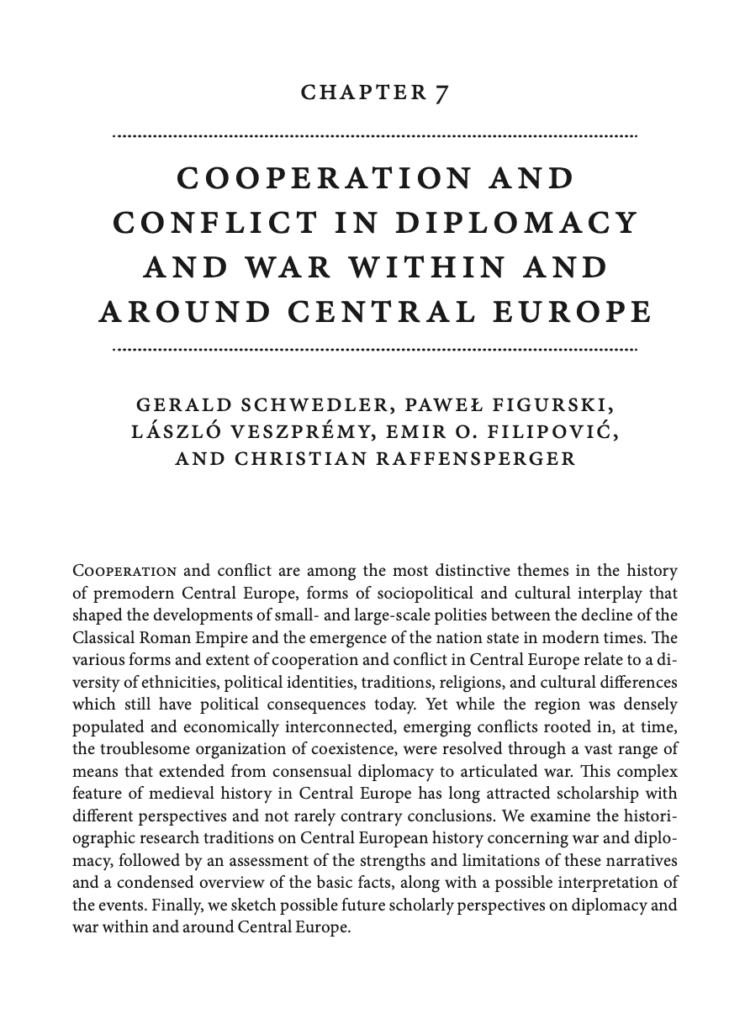
A general overview of Polish history in the Middle Ages.
*
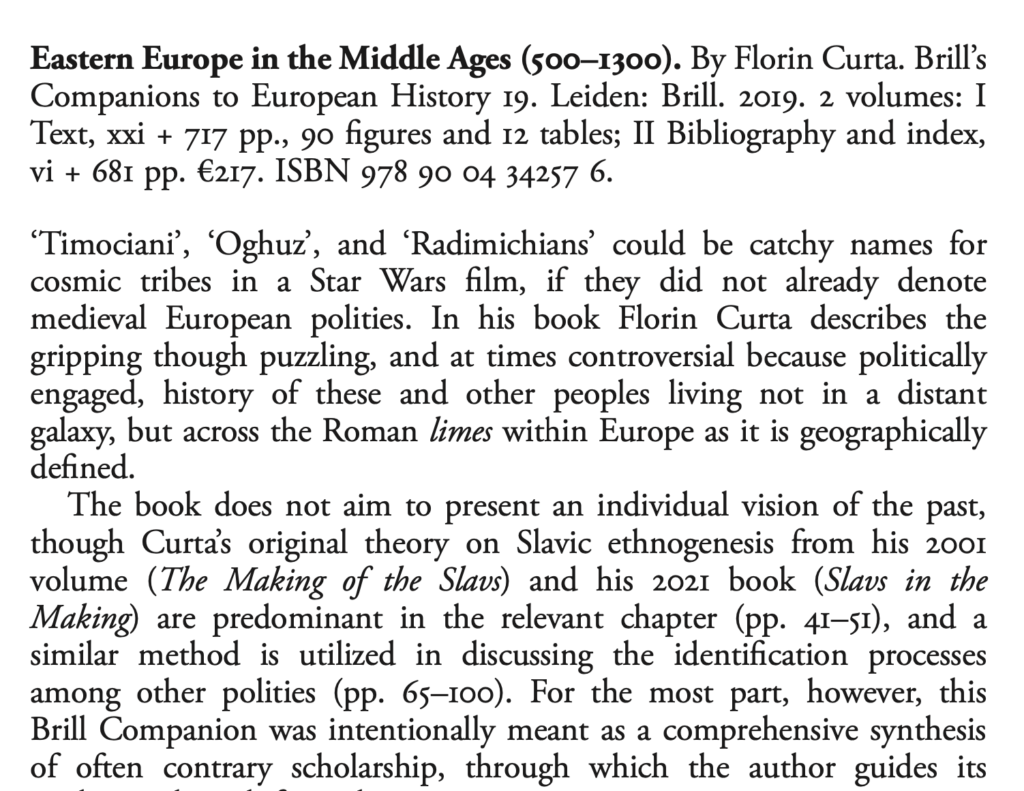
9. Review of: Florin Curta, Eastern Europe in the Middle Ages (500–1300), 2 vols (Leiden: Brill, 2019) in: Early Medieval Europe 29/3 (2021): 620–2.
*
10. “Occasional Rites for Urgent Causes (e.g. war, journey, plague),” in: Brill Handbook of Medieval Latin Liturgy, eds. Daniel DiCenso, Andrew Irving (Leiden: Brill, 2023) – submitted.
A short contribution to the companion to medieval liturgy, also consisting of the case study of PL-Kj 2057.
*
11. “Court versus Region in Making Liturgy,” in: Brill Handbook of Medieval Latin Liturgy, eds. Daniel DiCenso, Andrew Irving (Leiden: Brill, 2023)- submitted.
A short contribution to the companion to medieval liturgy, referencing D-DÜl C 91 and PL-Wn BOZ 8.