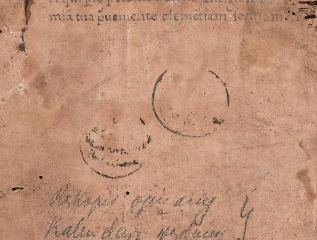
When I started the project in late 2018, I could not have imagined that academic research might resemble the stories known from the adventurous movies. At times, I felt like Indiana Jones traveling to the most remote though picturesque sites, where Polish medieval manuscripts remain in the forgotten monasteries, the books, largely overlooked by scholars, not only full of dust but also enigmas to be solved. I was tracing the codices stolen from Poland during World War II and have found some of them on the other edge of the world. Archival research during the pandemic did not prove deadly, though, like so many of us, I have contracted the virus. Due to all this costly effort, I was analyzing meticulously the manuscripts at Trinity College in Cambridge and I was able to reveal the mysteries of the medieval history of Poland.
Unexpectedly for many, I have discovered that liturgy, as the all-encompassing phenomenon characteristic of premodern Europe, was the crucial factor in shaping medieval states, especially in medieval Poland. Although the issues of premodern ethnogenesis, early medieval state-formation, and political identification are the main fields of inquiry in recent historiography, including in Polish academia, scholars rarely refer to liturgical sources. However, during my research on liturgical codices, I have found concrete answers to the question of how the monarchies of the Piast ruling dynasty functioned. For instance, the first materially extant example of the new name of the territory governed by the first king of Poland appears in liturgical texts, foremost, the sequence in honor of St Adalbert (Annua recolamus) from the well-known manuscript from Bamberg (Staatsbibliothek, Msc. Lit. 5, fol. 97v). The chant aided in popularizing, within and without the Piast realm, the new name coined around 1000 to denote numerous territories conquered by the first king of Poland. Christian liturgy also enabled leaders to shape and interiorize the Polish political identity through the liturgical invocation of the name of a ruler. This phenomenon granted Piasts virtual omnipresence in the face of their physical absence, in regions defined by flux and chaos. The practice was an expression of political allegiance in newly conquered regions, where new sacral architecture was being constructed. In sum, liturgy shaped statecraft. This is true also for later periods, especially regarding the newly discovered pontifical of the 12th century. The codex, hitherto unknown to the academic community, was found in February 2020 in one of the ecclesiastical archives in southern Poland. The book contains prayers for occasional needs and benedictions of various objects, including the sword, the sandals, and the staff. Since some of the manuscript’s elements include the liturgies of war, this posits a link between the codex and the military campaigns against the non-Christians conducted by the Piast ruling dynasty in the High Middle Ages. The emerging crusades on the Baltic rim required spiritual support, evidence of which provides the newly found pontifical. Hence, in the project, I brought to light the survived corpus of liturgical manuscripts that are usually excluded from meticulous treatment in the Polish narratives on medieval culture. Thanks to this it was possible to reconstruct more concretely the political ideas conveyed by the prayers for rulers and the influence of liturgy on the ideology of power. The ritual attire, woven out of various liturgical traditions in the Carolingian period, also clothed Piast rulers at the peripheries of Latin Christianity, though in a much humbler form. Still, the examples of the political liturgy in the Polish kingdom have been sufficient to forge our understanding of Piast rulership as an inner-ecclesiastical office, similar to other sacramentally ordained hierarchs of the Church. The earthly kingdom of the Piasts signified the heavenly one of God.
Liturgy, even though remains mostly the domain of the theologians, has been proven crucial to reconstructing the political and social history of the Polish Middle Ages. The attention devoted to the single manuscripts, hitherto overlooked by scholars, brought to the fore new evidence for reconstructing Polish history. Apart from the twelfth-century pontifical, I have identified early fourteenth-century fragments of the calendar with Polish names of months, as well as a thirteenth-century missal with numerous prayers of political significance. It was also possible to find books stolen from Poland during World War 2 and identify their provenance. Finally, due to the analysis of hundreds of manuscripts with the traditional (codicology, paleography) and modern (python, SQL) methods, it was possible to verify the hitherto, largely inaccurate descriptions of the liturgical manuscripts from Poland. The Polish manuscripts, those most ancient and most precious, though largely overlooked by scholars, received proper descriptions, and the new life. The codices themselves revealed the world of Polish medieval society, at times brutal, at times full of passion and love.